If you’ve ever stood in your kitchen holding an empty roll of paper towels, a drawer full of plastic produce bags, and a vague sense of “I should really cut down on this stuff,” you already understand the problem a starter kit is trying to solve.
Going low-waste sounds simple until you actually try to start. Suddenly there are a hundred swaps, a thousand brands, and endless opinions about which bamboo toothbrush is the right bamboo toothbrush. Most people don’t quit because they stop caring. They quit because they get stuck deciding.
That’s the real appeal of the best zero waste starter kits: someone has already done the choosing for you. You get a small box of genuinely useful reusables, you start using them, and you build momentum before the overwhelm sets in.
This guide walks through what these kits actually are, what to look for before you spend a cent, and which kinds of kits work best for different people and budgets. I’ve leaned on what real retailers are currently selling and what verified buyers say in their reviews — including the stuff that doesn’t work as advertised, because you deserve to know that too.
A quick, honest note up front: prices and kit contents change often, and retailers reformulate bundles all the time. The numbers below are ballparks to set expectations, not guarantees. Always confirm the current price and item list on the seller’s own page before buying. A good kit is just a shortcut to the habits behind a full zero waste lifestyle.
Why Use a Zero Waste Starter Kit?

A zero waste starter kit is a curated bundle of reusable, low-waste products designed to replace the single-use items you reach for every day — think reusable produce bags, a stainless or bamboo cutlery set, beeswax wraps, a safety razor, or solid toiletry bars. These kits typically range from around $20 to $100 depending on what’s inside and which brand you choose.
Here’s why a kit beats trying to assemble everything yourself when you’re just starting out:
- It removes decision fatigue. You don’t have to research forty products. You get a sensible starting set and learn what you actually like through real use.
- It bundles related items. A kitchen kit, a bathroom kit, or a shopping kit gives you a working system instead of one lonely swap that doesn’t change much on its own.
- It usually costs less than buying à la carte. Most retailers price bundles at a discount — commonly 10% to 30% off the individual items.
- It makes a genuinely good gift. A starter kit is one of the easiest ways to nudge a curious friend or family member toward eco-friendly habits without lecturing them.
Think of it as training wheels. The goal isn’t a perfect, plastic-free life by next Tuesday. It’s replacing a handful of throwaway items with reusable ones you’ll actually keep using.
What to Look for Before Buying

Not all eco friendly starter kits are created equal. Some are thoughtfully curated; others are random reusables shoved in a box with a green label. Use this checklist to tell them apart.
Match it to your real routine. The best kit is the one full of things you’ll genuinely use. If you never cook, a kitchen-heavy kit will gather dust. If you shop at a farmers market every weekend, produce and bulk bags will earn their keep immediately.
Check the materials. Look for honest, durable materials: stainless steel, glass, organic cotton, bamboo, and food-grade silicone. Food-grade, platinum-cured silicone is widely considered the safest reusable food-storage material — it doesn’t leach, it handles boiling and freezing, and it can last well over a decade. For produce bags, GOTS-certified organic cotton is the gold standard.
Look at end-of-life. Truly good zero waste products tell you what happens when they wear out — whether they’re refillable, recyclable, or backyard compostable. A bamboo toothbrush with compostable bristles, or a safety razor with a blade take-back program, is the kind of detail that signals a quality kit.
Count the genuinely useful pieces. A “20-piece kit” sounds impressive, but ask yourself how many of those pieces you’d actually reach for. Five items you use daily beat twenty you don’t.
Read the reviews — especially the critical ones. Real buyers will tell you if the dish soap bar turns to mush or the safety razor has a steep learning curve. That’s gold.
Common mistakes beginners make
A few traps catch almost everyone at the start:
- Throwing out perfectly good plastic to “go zero waste.” Tossing items you already own and replacing them with new purchases creates more waste, not less. Use what you have until it wears out, then swap.
- Buying the aesthetic, not the function. A beautiful kit you don’t use is just expensive clutter.
- Going all-in overnight. People who try to swap everything at once usually burn out. One or two habits at a time is what sticks.
- Forgetting the “use it” part. The reusables only help if they leave the drawer. Keep them visible and within reach.
Best Overall Zero Waste Starter Kits
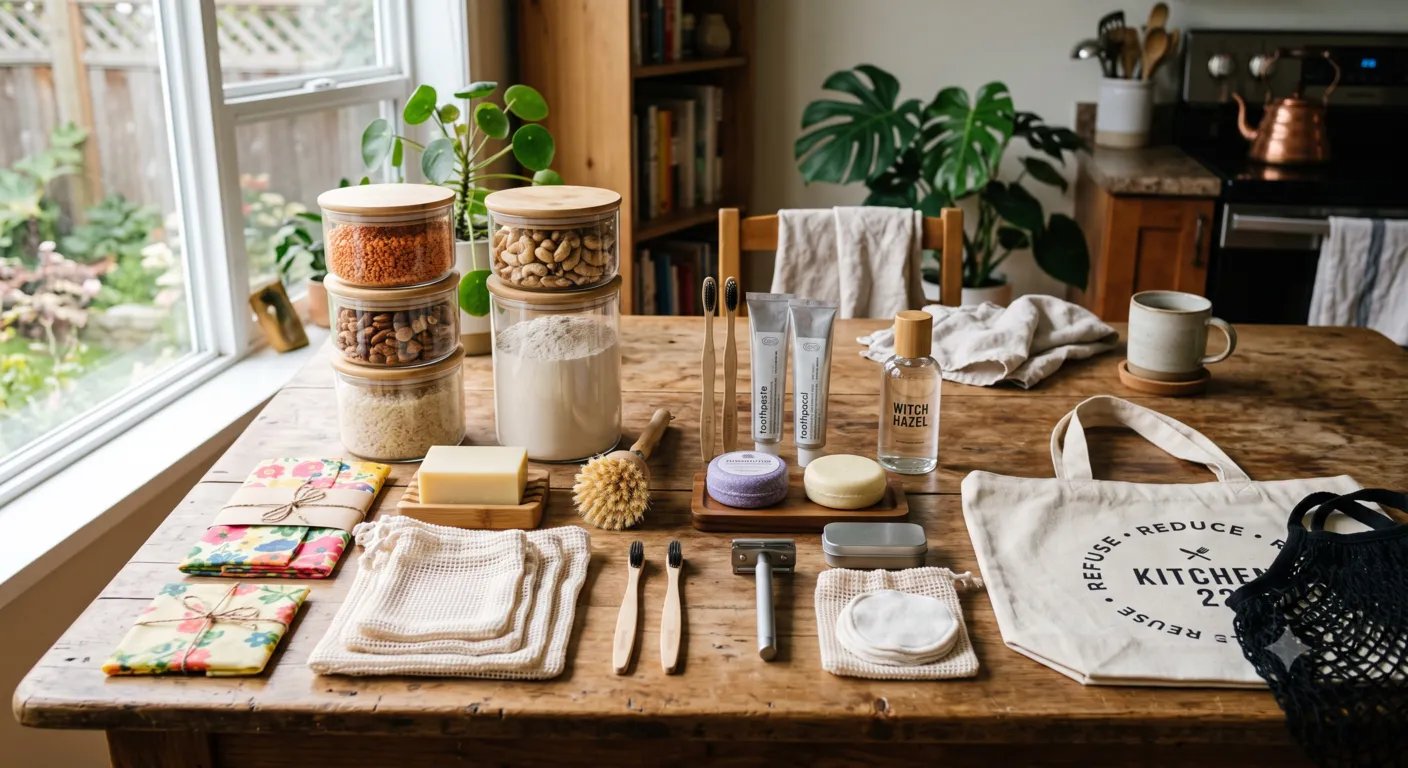
Best for: Beginners who want one balanced kit that covers a bit of everything.
The strongest all-rounders come from established plastic-free retailers like Zero Waste Store, EcoRoots, and Package Free Shop, which build broad starter bundles spanning the kitchen, bathroom, and on-the-go essentials in a single box.
A good example of the category is Zero Waste Store’s multi-piece starter kit. The retailer describes it as a 16-piece set that its team hand-picked, tested, and approved, built specifically to replace everyday items with simple swaps. A kit like this typically includes things such as reusable “Swedish” sponge cloths, a bamboo toothbrush, mesh and muslin produce bags, a cotton tote, reusable straws, and sometimes a safety razor — a genuine cross-section of daily swaps rather than a single category.
If you’d rather not be stuck with items you won’t use, several of these retailers now let you build your own kit from their bestsellers at a bundle discount. Zero Waste Store, for instance, offers a customizable starter kit at up to 25% off while supplies last. That flexibility is often the smartest “overall” choice, because you get the convenience of a bundle without paying for things that don’t fit your life.
Roughly what you’ll pay: Full curated kits often land in the $60–$100 range; build-your-own bundles can come in lower once the discount is applied.
The honest catch: Broad kits spread across categories mean a few items may not match your habits. Skim the full contents list and be honest with yourself about what you’ll actually use.
Best Budget Option

Best for: People who want to start cheaply, gift-givers on a tight budget, and anyone testing the waters.
You don’t need to spend a lot to begin. There are two solid budget routes.
Route 1: An affordable multi-piece kit. Marketplaces like Amazon are full of inexpensive bundles aimed at beginners. A typical example is a 17-piece kitchen-focused set that includes several sizes of mesh produce bags, beeswax food wraps, reusable zip-style bags, and reusable straws with a cleaning brush and travel pouch. For the money, you get a working starter set covering shopping and food storage.
Route 2: A five-item DIY kit. Honestly, the cheapest “kit” is one you assemble from a few key swaps and items you partly own already. A reusable water bottle, a cloth tote, a set of produce bags, a reusable cutlery set, and a beeswax wrap or two will handle the majority of your single-use habits. For the tote and produce bags specifically, see our best reusable grocery bags of 2026. Reusable produce bags alone can replace roughly 500 single-use plastic bags a year for a household that shops weekly, according to estimates from the Plastic Pollution Coalition.
Roughly what you’ll pay: A budget multipack commonly runs about $25–$40. A DIY five-item kit can cost even less if you already own a bottle or some containers.
The honest catch: Cheaper bundles can be hit-or-miss on quality, and you may not love every piece. Check what the items are actually made from, and treat the kit as a starting point you’ll upgrade over time rather than a forever set.
Best Premium Option

Best for: Buyers who’d rather spend once on durable, buy-it-for-life pieces — and gift-givers who want something that feels special.
Premium kits aren’t about more stuff; they’re about better, longer-lasting versions of the essentials, often beautifully packaged. The value comes from items you’ll genuinely keep for years.
The anchor piece in most premium kits is a quality metal safety razor. Retailers reasonably call a good stainless safety razor “the last razor you’ll ever buy” — it can last for decades, and you only ever replace the inexpensive blade. Brands like Albatross even include a blade take-back program, sending you an envelope to collect used blades for recycling. Pair that with durable stainless food storage, a high-quality organic cotton tote, and premium toiletry bars, and you have a kit built to outlast a dozen disposable equivalents.
For a gift, look for a kit that includes a guide to the lifestyle. Some premium starter gift boxes bundle in a book like Kathryn Kellogg’s 101 Ways to Go Zero Waste — a thoughtful touch that helps a beginner understand the why, not just the what.
Roughly what you’ll pay: Premium and gift-box kits often range from about $90 to $150 and up, depending on how many durable, high-end pieces are included.
The honest catch: Don’t pay premium prices for items you won’t use. The safety razor is the classic example — it gives a close, low-irritation shave, but there’s a real learning curve. Some reviewers love it; others report nicks and irritation while they adjust to the technique. Go slow, use plenty of lather, and give it a few weeks.
Best Family Starter Kit

Best for: Households with kids, busy parents, and anyone feeding more than one person.
Here’s a bit of straight talk: very few kits are explicitly labeled “for families.” The smart move is to build a household-scaled kit around the spots where families generate the most single-use waste — lunches, snacks, and shopping.
A practical family kit looks like this:
- Reusable snack and sandwich bags (a multipack). This is the highest-impact family swap. Silicone bags like Stasher use food-grade platinum-cured silicone and are dishwasher- and freezer-safe; they typically cost around $12–$18 each. A practical tip from parents: let your kids pick the prints or colors — they’re far more likely to actually use them (and less likely to lose them).
- A stainless bento box or two. Brands such as PlanetBox, LunchBots, and ECOlunchbox make compartmentalized stainless lunch boxes built to survive years of school runs.
- Reusable water bottles for everyone. A durable insulated bottle (Hydro Flask, Klean Kanteen, and similar) ends the juice-box-and-disposable-bottle cycle — see our best reusable water bottles of 2026 for specific picks
- Reusable produce bags and a few beeswax wraps for groceries and leftovers.
- Refillable household swaps: refillable cleaning sprays (Blueland and similar) and plastic-free laundry detergent sheets (Earth Breeze and similar) cut down on the bulky plastic jugs that pile up in family homes.
The payoff can be real money over time. ECOlunchbox, for example, estimates families who switch away from disposable lunch bags and pre-packaged snacks save in the neighborhood of $435 a year — a brand estimate, but a believable one once you stop buying boxes of zip bags every month.
Roughly what you’ll pay: Building this out runs anywhere from about $60 to well over $120 depending on how many bottles, boxes, and bags your crew needs. Spread it over a couple of months if that’s easier.
The honest catch: With picky eaters, ease into it. Start by packing familiar foods in the new reusable bags, and use smaller portions so less comes home uneaten. And again — don’t toss the plastic containers you already own. Phase them out as they wear down.
Best Travel Starter Kit

Best for: Commuters, frequent flyers, road-trippers, and anyone who eats on the go.
Travel is where single-use plastic piles up fast: takeaway cutlery, hotel toiletry bottles, coffee cups, and plastic straws. A compact travel kit keeps you covered without weighing down your bag.
The essentials of a great zero waste travel kit:
- A collapsible cutlery-and-straw set in a pouch. Compact sets pair a telescopic stainless straw and foldable utensils in a keychain pouch small enough to fit in a back pocket. Bamboo cutlery sets with a carry pouch are another lightweight favorite.
- A packable tote. A foldable tote like the Baggu Reusable Tote handles groceries, souvenirs, and daily carry without a single plastic bag.
- A collapsible cup or bowl that flattens down for coffee, smoothies, or picnic meals.
- Solid toiletries: a shampoo bar, conditioner bar, and toothpaste tablets in a ventilated tin. Let bars dry fully before storing, ideally in a soap case with drainage, so they don’t crumble.
- A reusable water bottle — the single most useful piece in the whole kit.
A real-world TSA tip: Solid toiletries, bamboo cutlery, and silicone bags are generally fine to carry on, as long as any refilled liquid containers follow the standard liquid limits. The exception to watch is a metal knife — it can get flagged at security, so check the current TSA rules before you fly or pack the knife portion in your checked bag.
Roughly what you’ll pay: A compact travel kit usually runs about $20–$45, depending on whether you add solid toiletries and a bottle.
The honest catch: Don’t over-pack the kit. One traveler’s hard-won lesson is that a full bamboo cutlery roll can take up more room than it’s worth — many people end up preferring one simple, easy-to-clean utensil that fits inside a small container. Bring what you’ll realistically use, not the whole catalog.
Are Starter Kits Worth It?

Short answer: for most beginners, yes — with one important caveat.
A starter kit is worth it when it gets you moving. If decision fatigue has been the thing standing between you and a lower-waste routine, a curated box is the fastest way past it. You start using real reusables today instead of researching for three weeks and doing nothing.
It’s not worth it if it just becomes a pile of unused products, or if it nudges you to replace things you already own. That’s the opposite of waste reduction. The whole point is using less, not buying a green-labeled version of everything you’ve got.
The honest trade-off comes down to convenience versus customization. Pre-made kits are ideal for beginners, last-minute shoppers, and gifts. Assembling your own kit takes more effort but usually gets you higher-quality items, a better fit for your life, and more savings over time.
So the best value isn’t “the most pieces” or “the cheapest box.” It’s a kit that matches a habit you actually have. Buy the kitchen kit if you cook. Buy the travel kit if you commute. Skip the rest until you’re ready.
And remember the bigger picture: many of these swaps pay for themselves. Plastic-free swaps often recoup their cost within roughly three to six months compared with buying the single-use version over and over. A reusable item that lasts years and replaces hundreds of disposables is rarely a bad deal.
Frequently Asked Questions
What is a zero waste starter kit?
A zero waste starter kit is a bundle of reusable, low-waste products meant to replace common single-use items in your daily life — things like produce bags, reusable cutlery, beeswax wraps, a safety razor, and solid toiletry bars. It’s designed to give beginners an easy, all-in-one starting point.
What should a beginner zero waste kit include?
At minimum, look for a reusable water bottle, a cloth tote, reusable produce or bulk bags, a reusable cutlery set, and a wrap or container to replace plastic wrap. Many beginner zero waste products also include a bamboo toothbrush and a metal straw. Start with whatever matches your daily routine.
How much does a good zero waste starter kit cost?
Most kits fall somewhere between about $20 and $100. Budget multipacks run roughly $25–$40, a balanced all-rounder is often $60–$100, and premium or gift-box kits can reach $150 or more. Bundles usually cost less than buying the same items separately.
Are zero waste starter kits actually worth the money?
For beginners, usually yes — they remove the guesswork and help you build habits quickly, and most reusables pay for themselves within months. They’re only a waste of money if the items go unused or if you replace things you already own instead of using what you have.
Can I make my own zero waste kit instead of buying one?
Absolutely, and it’s often cheaper and better-tailored. Pick five swaps that fit your routine and gather them gradually — many people already own a bottle or some containers to start with. The downside is that it takes more research and time than grabbing a ready-made kit.
Is a truly “zero waste” lifestyle even realistic?
Not perfectly, and that’s okay. Zero waste is a direction, not a finish line. The goal is steady, imperfect progress — replacing single-use items with reusables one habit at a time. Consistency matters far more than perfection.
Final Verdict
If you take nothing else from this guide, take this: the best zero waste starter kits are the ones you’ll actually use. Match the kit to your real life and you’ll stick with it; buy on looks or hype and it’ll sit in a drawer.
Here’s the quick rundown by category:
- Best overall: A balanced, team-curated kit (or a build-your-own bundle) from an established plastic-free retailer — broad coverage, beginner-proof.
- Best budget: An affordable multi-piece marketplace kit, or a five-item DIY kit you assemble yourself.
- Best premium: A durable, buy-it-for-life bundle anchored by a quality safety razor and stainless storage — ideal as a gift.
- Best for families: A household-scaled kit built around lunch and snack gear, reusable bottles, and refillable cleaning swaps.
- Best for travel: A compact set with collapsible cutlery, a packable tote, solid toiletries, and a reusable bottle.
Whatever you choose, start small, use what you already have, and let one or two habits settle in before adding more. That’s how a starter kit turns into a genuinely lower-waste life — not through a single perfect purchase, but through the everyday choices you keep making after the box is empty.
Prices and kit contents change frequently. Confirm current details on the retailer’s own product page before buying.